


international forefront|The next wave of innovation in medical laboratories: Automatic review and PBRTQC

2023-10-10 2593


International Frontier Express


Dean of the Faculty of Science at the Royal Australian College of Pathologists, Royal Australian Pathologist Quality Assurance Program (RCPAQAP) Chief Executive Officer, Former President of the Australian Society of Clinical Biochemistry Tony Badrick Professor in 2023 Year in Clin Chem Lab Med Magazine publishes a review on the next stage of development direction of medical laboratory automation innovation transformation, Elaborated on the innovative changes experienced by medical laboratories at different stages, The first stage of innovation and transformation in clinical laboratories is the improvement and application of automation equipment; The second stage of innovation and transformation is the laboratory ISO15189 Establishment and Development of Quality Management System; And propose that the main direction of the third stage of innovation and transformation is automatic review and real-time quality control of patient data (PBRTQC) wait, The main content is as follows:


640  (9) . png

Tony Badrick professor


Overview Summary
The automation of clinical laboratories has had a significant impact on clinical testing, Greatly improved the efficiency of detection. Full laboratory automation (TLA) In clinical biochemistry, Clinical Immunology, Sample processing has been achieved in hematology and clinical microbiology, Automated processing of analysis and storage, Liberate inspectors from tedious work. however, There are still many tasks that must be manually performed by operators. With further platform integration and the widespread application of molecular biology techniques in clinical laboratories, The exploration of laboratory automation is becoming increasingly complex, in this regard, New real-time quality control measures can be effective, Adopting real-time quality control scheme, More out of control situations can be discovered. To reap the benefits of the new quality control process, The most important thing is to ensure automated processes, Simultaneous implementation of real-time quality control measures and automatic review of inspection results, Therefore, The best solution is a combination of automation and manual processing, And make quality control an integral part of laboratory automation that cannot be separated.


Overview Main Content
self 20 century 80 Since the era, Full laboratory automation (TLA) The concept of saving laboratory human resources is widely recognized, It has played an important role in improving sample turnover time and enhancing detection quality, Significant progress has been made in laboratory automation.

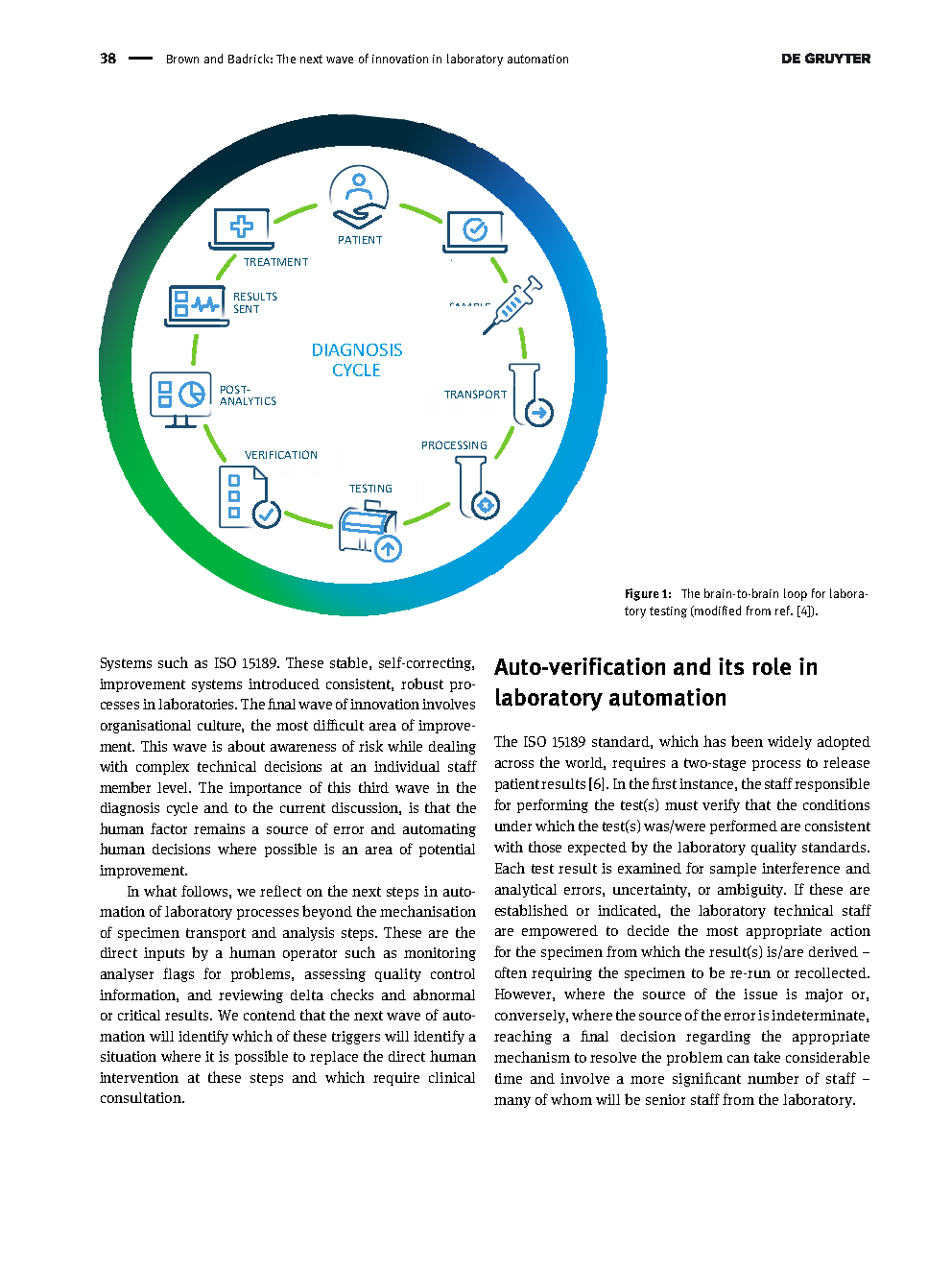
so far, Innovation drives the transformation of medical laboratories in three stages, The first stage of transformation involves updating and upgrading equipment, The development of automated analytical equipment has completely changed clinical chemistry and hematology testing, Reduced analysis errors and enabled rapid generation of results; The second stage of transformation is the development of laboratory quality management system, as ISO 15189; The third stage of transformation involves automatic auditing, Quality Control and Sample Quality Assurance System, This wave of change is about clinical laboratory workers' understanding of risks when dealing with complex technological decisions.


1, Automatic review and its role in laboratory automation
currently, Many laboratories embed simple automatic audit rules into laboratory information systems during the analysis process (LIS) Or intermediate software. This type of rule can be used to manage results that meet the requirements, And minimize manual intervention to the greatest extent possible. for example, If all quality control information and sample status audits have been approved, The result is normal or close to normal and no other rules have been triggered (as, Special samples or situations that require communication with a doctor) , No further manual intervention is required, According to the embedded rules, one can LIS Send out results in the middle. Evidence suggests that, Clinical Decision Support System (CDSS) The application can also significantly improve the automatic review rate, Thereby reducing manual intervention and improving work efficiency. Further reliance on software can significantly improve the automation level of laboratories, Provide patient-centered standardized interpretation of results.


2, Laboratory Information System and Electronic Medical Records (EMR) The interaction effect
The development of this field can be achieved through laboratory adoption CDSS Software driven automation process in the post analysis process and understanding of clinical authorization. Linking health data is one of the most critical factors, correlation LIS and EMR The ability to store data in the laboratory will enable laboratory medicine experts to conduct comprehensive patient-centered analysis when problems arise. through CDSS Can summarize data from two sources, Use all available data and automatically generate and authorize according to rules, Create intelligent and informative annotations.


3, Real time quality control based on patient data (PBRTQC) And its role in laboratory automation
The guiding significance of laboratory test results for clinical diagnosis and treatment cannot be ignored, The requirements for accuracy and precision of test results have driven the development of clinical laboratory quality control, The advancement of technology has greatly improved the quality and analytical performance of automated analytical instruments used in modern medical laboratories. laboratory QCAccording to the institutional quality system regulations, The activity of evaluating all detection and analysis processes using quality control products on a periodic basis. However, this method of evaluating the analytical performance of a testing system by regularly testing quality control products has inherent problems, Issues such as matrix effects of quality control products and determining appropriate quality control testing intervals.

The shortcomings of traditional laboratory quality control methods include:
※Unable to detect long-term system deviations
The clinical significance of imprecision at low concentration quality control levels
※Failure to detect small positive biases at the lower limit of sensitivity and failure to promptly detect significant changes in the analytical performance of the detection system
※The handling of quality control loss of control is not simple

The above-mentioned problems of traditional laboratory quality control methods, Encourage medical laboratories to tryAdopting real-time technologyornear real-timeAlternative indoor quality control solutions, In order to detect potential problematic test results in advance, Instead of relying on recalls and redoing samples. Real time quality control based on patient data (PBRTQC) It is a technology that requires specialized software for quality control based on patient sample testing results, There are currently many different algorithms available, PBRTQC has many advantages, Avoiding matrix effects. As the laboratory gradually realizes PBRTQC The benefits of, PBRTQC It is being adopted more widely, Generate real-time QC data PBRTQC Can directly interact with the analysis system software, If bias is detected in the system, Can directly recalibrate and detect affected patient samples.

Real time quality control based on patient data (PBRTQC) advantage:
※Performance analysis of long-term continuous monitoring and testing system, This provides a powerful tool, Can be integrated into middleware and automatically respond to out of control alerts.
PBRTQC The rules are easy to understand, Under control or out of control, No requirement to review previous quality control data.
※Many out of control quality control results and the handling of quality control products, Related to preparation or storage, PBRTQC Can avoid these errors.
※The instrument software can recognize failures QC Identify and automatically retest patient samples, Recalibrate or remind operators of reagent issues, etc.
※in QC The procedures to be followed in case of loss of control can also be described and embedded in middleware, So as to improve the automation level of quality control out of control handling, Promote the application of artificial intelligence in indoor quality control.


4, Human factors in laboratory errors
Using artificial intelligence to analyze instruments, Electronic Medical Record System, PBRTQC and PBQA All real-time data feedback from the system and manufacturer instruments, For further elimination TLA The weak links in the chain are crucial. A recent global survey found that, Most laboratories around the world not only have a strong interest in digital innovation, And they are equally enthusiastic about collaborating with healthcare professionals and suppliers to achieve this transformation.


Conclusion
In summary, PBRTQC Obviously, it is possible to further revolutionize clinical laboratories TLA The concept. The limitations of laboratory staff in dealing with the aforementioned complex technical issues, The best solution is to automate the steps that require manual intervention, These decisions will have a significant impact on the diagnosis and treatment of patients. These processes determine when to detect "controllable" , Patient results can be published, Integrating artificial intelligence into analytical systems, Relying on a continuous dynamic monitoring and detection system to replace manual decision-making to achieve this goal. These new quality management tools are exciting, Utilize the existing testing data in the laboratory and apply it to improve and enhance the quality management system. The laboratory is in the next stage of reform to reduce patient test result errors, It will be composed of middleware and new QC technology-driven, Continuous monitoring and analysis of performance and pre analysis errors, All laboratories should use a quality indicator system to evaluate and monitor the impact of laboratory testing on patients.

Excerpted from: Clin Chem Lab Med 2023; 61 (1) : 37–43
1. png
2. png
3. png
4. png
5. png
6. png
7. jpg
Compiled from "clinical laboratory" 2023 year 8 moon "Laboratory Automation, digitalization, intelligentization" In the special issue "The next wave of innovation in laboratory automation: auto review, Quality Control and Sample Quality Assurance System" One article